Are body kits, spoilers and GT wings legal in the UK? MOT, insurance and TÜV explained
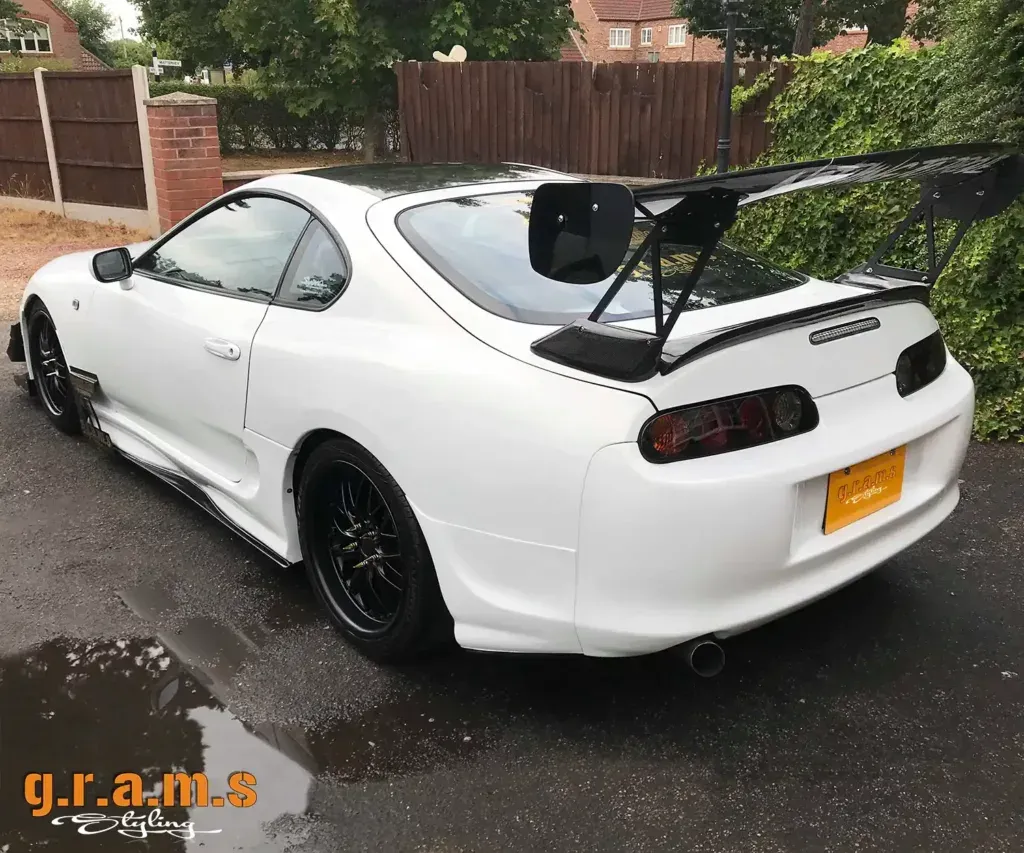
"Is this road legal?" is a question we get for almost every wing and splitter we sell. Most answers online come from forums, and they rarely quote the rules. This guide quotes them. It covers the UK MOT, the insurance side and, for our customers in the EU, how TÜV approval works.
This is a practical guide from a parts maker, not legal advice. If you are unsure about a specific build, ask your MOT tester or your insurer before you fit the part.
Short answer
In most cases, yes. In the UK, body kits, spoilers, splitters, diffusers and GT wings are generally allowed on a road car as long as they:
- are securely fixed;
- are not likely to cause injury to someone who brushes against them;
- do not hide your number plate or lights;
- are declared to your insurer.
The MOT has no rule on how big or how wide a rear wing may be. The general width limit for vehicles still applies: a car may be no wider than 2.55 m, and that width includes most fittings attached to it, so a wing counts too (regulations 3 and 8 of the Road Vehicles (Construction and Use) Regulations 1986). A wing for a road car does not come close to that. What matters in practice is how it is made, how it is fixed and how it is finished.
What the MOT manual says
The MOT inspection manual for cars lists "spoilers" and "undertrays" among the parts checked under section 6.2.1, "Body condition". The defects that matter for aero parts are:
- Major: "A body panel or body component damaged or corroded and likely to cause injury when grazed or contacted, or insecure"
- Dangerous: "A body panel or body component likely to become detached"
- Major: "Body has an unsafe modification", where the manual defines an unsafe modification as "one that is likely to cause injury"
Source: MOT inspection manual, section 6: body, structure and attachments (GOV.UK).
In practice, a tester looks at three things: is it loose, is it cracked or broken, and could it hurt someone? A well-fitted wing with rounded edges is unlikely to be a problem. A cracked splitter hanging off one bolt does not.
Away from the MOT, regulation 100 of the Road Vehicles (Construction and Use) Regulations 1986 requires every part and accessory of a vehicle to be kept in a condition where it does not cause danger. A part that falls off on the motorway is your responsibility whatever the MOT certificate says. Source: legislation.gov.uk.
Sharp edges and end plates
The MOT does not give a number for how sharp an edge may be. New cars do have one: the type-approval rules on external projections (UN Regulation No. 26) generally ask for exposed edges to be rounded to a radius of at least 2.5 mm. That rule does not apply to your MOT, but it is a good target for any part that sticks out.
What it means for your build:
- Round off the corners of wing end plates and splitter ends. Do not leave a freshly cut edge.
- A splitter that sticks far forward of the bumper is the part most likely to catch a pedestrian's leg. Keep the overhang sensible on a road car.
- Seal and smooth every edge you trim during fitting.
GT wings: what to check
A GT wing is generally allowed on a UK road car. The MOT sets no size for it, but the car with its wing must stay within the 2.55 m width limit. Check these points before you fit one:
- Mount it to structure. Wing legs should bolt through the boot lid with backing plates, or to the chassis on a track car. Tape and small screws are not enough for a part that carries load at speed.
- Keep the number plate and lights visible. A low wing or wide end plates can hide the third brake light or part of the plate.
- Think about your view. A wing in line with your rear window is not an MOT item in itself, but your mirrors must still give you an adequate view to the rear.
- Choose the mount for the job. On a swan neck mount the legs hold the wing from above, which leaves the underside of the blade clean. That underside does most of the work, so swan neck mounts suit performance builds. Pedestal legs, such as our triangle and ellipse legs, are simpler to fit and suit most road cars.
Does a wing do anything at road speeds? Downforce grows with the square of speed: at 70 mph you get about four times the load you get at 35 mph. On the road the effect is small. On a track it is real, and a big rear wing usually needs a front splitter to keep the car balanced. Our front splitter guide explains the front end.
Insurance: declare it
This is the part that costs people money. Under the Consumer Insurance (Disclosure and Representations) Act 2012, "It is the duty of the consumer to take reasonable care not to make a misrepresentation to the insurer" (section 2). Insurers ask about modifications, and most count a body kit, spoiler or splitter as one even if it is only cosmetic.
If you do not declare it, the insurer can reduce a claim payout, refuse it or cancel the policy, depending on how the misrepresentation is judged. Declaring it often makes little or no difference to the premium, and some insurers specialise in modified cars.
- Tell your insurer before you fit the part, or as soon as it is on.
- List each part: "front splitter", "rear wing", "side skirts", not just "body kit".
- Keep your invoice, so you can show what was fitted and what it cost.
Buying from the EU: TÜV and inspections
Rules differ between EU countries. In Germany, many aero parts must be inspected by TÜV or another inspection body before you can use them on the road, often with a parts certificate that helps the inspector. Other countries have their own procedures: some check modifications at the periodic technical inspection, others need a separate inspection for some changes.
We provide part certificates for TÜV registration on request. Send us your order number and we email the certificate. Ask your local inspection body what else they need before you fit the part.
A quick pre-fit checklist
- Test fit the part before you drill, cut or paint, and check our returns page before you order.
- Fix load-carrying parts (wings, splitters, diffusers) to metal, not just to plastic trim.
- Round off and seal every cut edge.
- Check that the number plate and every light are fully visible.
- Tell your insurer.
- In the EU, ask us for the TÜV part certificate if you need one, and book any inspection your country requires.
Not sure about a specific part on your car? Ask us before you order.
FAQ
Is a GT wing road legal in the UK?
Generally, yes. The MOT has no size rule for a rear wing, but the car, wing included, must stay within the general 2.55 m width limit for vehicles. The wing must be securely fixed, must not be likely to cause injury, and must not hide the number plate or lights. You should also declare it to your insurer.
Will a body kit fail an MOT?
Under the body checks, it fails if a part is insecure, likely to fall off, damaged in a way that could cause injury, or an unsafe modification likely to cause injury. It also fails if it hides the number plate. A well-fitted body kit with smooth edges is unlikely to be a problem.
Do I have to declare a front splitter or spoiler to my insurer?
Yes. Most insurers count any change from the factory specification as a modification, including cosmetic parts. If you do not declare it, the insurer may reduce or refuse a claim or cancel the policy.
Does a spoiler increase insurance?
Sometimes slightly, often not at all. It depends on the insurer and the car. Not declaring it is the expensive option.
Do you provide TÜV certificates?
Yes. Part certificates for TÜV registration are available on request. Contact us with your order number.
More from the blog

New Toyota Celica: what we know, and why the old Celicas still matter
What we know about the new Toyota Celica: what Toyota has said, Autocar's hybrid 4WD report, the 2027 WRC prototype and aero for older Celicas.

Nissan 200SX and Silvia S13, S14 aero guide: body kits and what fits
Nissan 200SX and Silvia S13, S14 aero guide: which body kits fit which car, Zenki vs Kouki fronts, Vertex and Boss V2 styles, drift or street.
Best body kit brands in Europe (2026): who makes what, where, and for which cars
GRAMS Styling, Maxton, Prior Design, Rieger, TECHART, BRABUS and Mansory compared on where parts are made, material, cars and price. By a maker.