How to store a car over winter in the UK: SORN, insurance and battery
If your car will not go on a public road until spring, the clean way to lay it up in the UK is: park it on private land, make a SORN with DVLA, then swap your road policy for laid-up cover. After that, keep the battery on a smart charger, add a few psi to the tyres, leave the handbrake off with the wheels chocked, and use a breathable cover. The order of the first three steps matters. GOV.UK rules quoted here were checked in October 2026. This is general information, not legal advice.
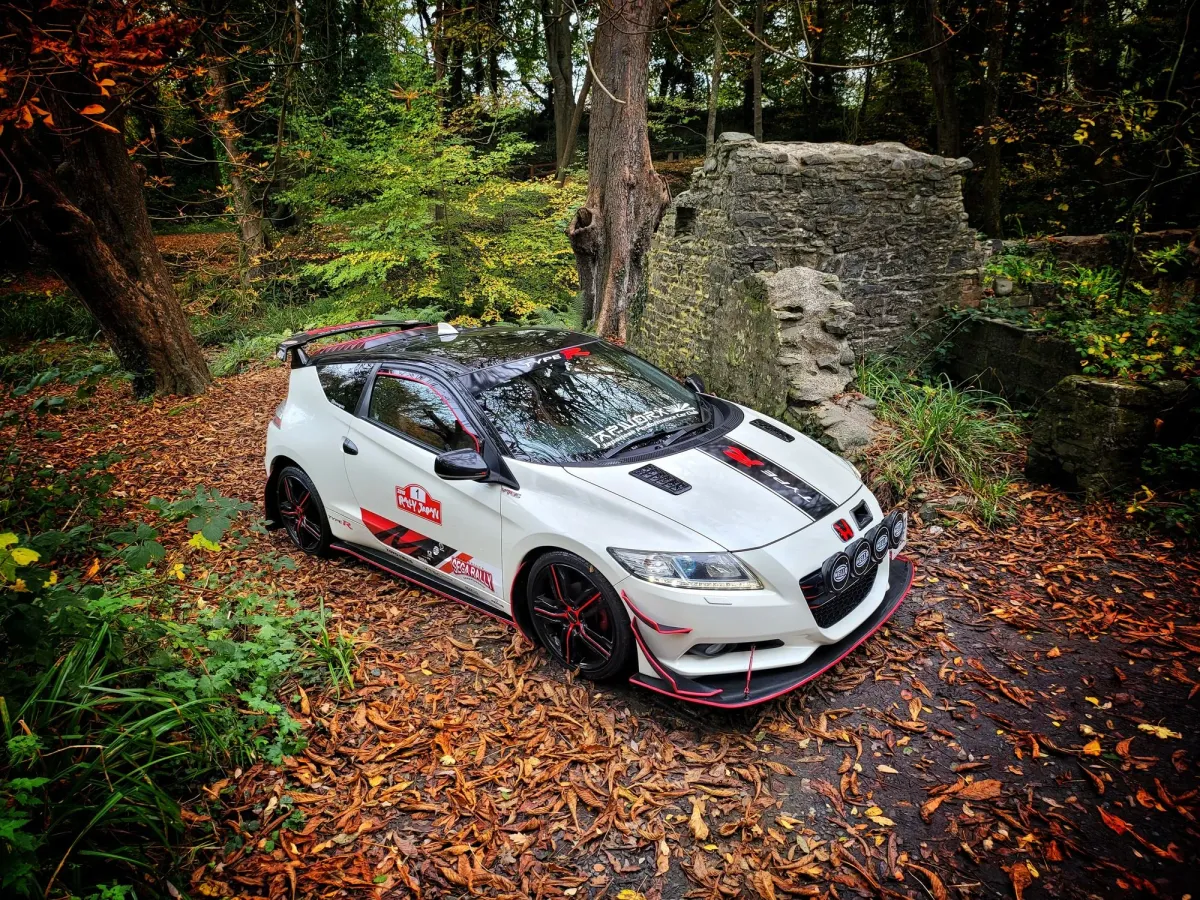
Many of the cars we make parts for are low, which brings its own storage problems, covered below. This CR-Z, with a front splitter, canards and rally lights, was photographed in the autumn leaves.
SORN or keep it taxed?
A SORN (Statutory Off Road Notification) tells DVLA the car is off the road, so you can stop taxing and insuring it. GOV.UK defines off the road as not kept or used on a public road, "for example if it's in a garage, on a drive or on private land". A car parked on the street cannot be on SORN: it has to stay taxed, insured and in MOT.
- You make it online, by phone or by post, using your V5C log book or tax reminder.
- It starts immediately, unless you apply in the month your tax runs out, when it starts on the first day of the next month. It cannot be backdated.
- You get a refund for any full months of tax left, and a Direct Debit is cancelled automatically.
- It does not need renewing. It ends when you tax the car again, or sell, export or scrap it.
The catch is driving. A SORN car may only go on a public road to or from a pre-booked MOT or other test. GOV.UK says any other use can mean prosecution and a fine of up to £2,500. So if the car winters in a storage unit, drive it there while it is still taxed and insured, then make the SORN. If it is already on SORN, it goes on a trailer.
Insurance: SORN first, then laid-up cover
England, Scotland and Wales run continuous insurance enforcement. GOV.UK says a car that is not insured must be on SORN. The keeper of an uninsured car that is not on SORN can get a £100 fine, have the car clamped or impounded, and face a court fine of up to £1,000. Make the SORN first and change the insurance second.
Insurance is not required on SORN, but a stored car can still burn or be stolen. Laid-up cover is the specialist answer: Lancaster Insurance offers fire and theft, or fire, theft and accidental damage. Conditions vary. Lancaster accepts a garage, a driveway or private land, while Heritage asks for the car to be garaged for the whole policy. Lockton, a broker, reminds owners that laid-up cover does not cover driving on the road.
Declare your modifications on the laid-up policy too. Our article on body kit legality and insurance in the UK covers disclosure. In Northern Ireland, which has its own rules, GOV.UK says continuous insurance enforcement does not currently apply.
Getting a low car into storage
A trailer ramp, a kerb or a garage threshold is a short, steep slope, and a front lip or splitter reaches it before the front tyres do. What decides whether it scrapes is the approach angle, not only the ride height. Our front splitter guide explains how to measure it.
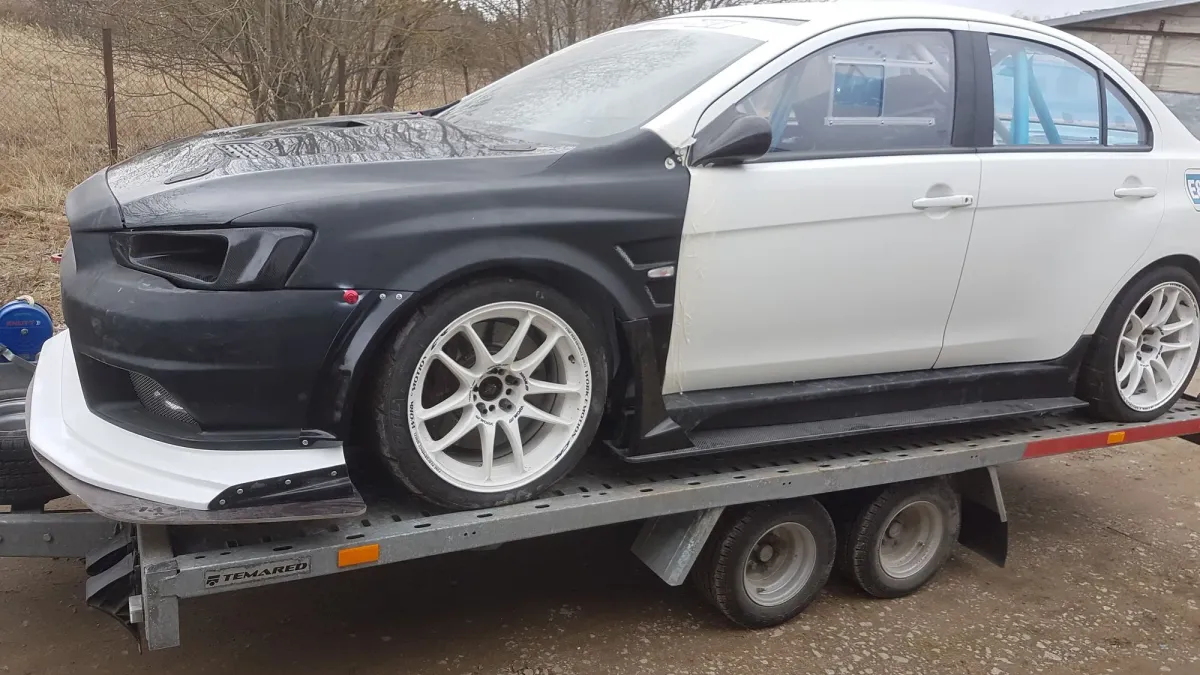
This Lancer Evolution X track car sits on a car trailer with its front lip and splitter hanging past the front of the deck. Our habits for low cars:
- Lay wide, solid timber planks flat on the ground under the feet of the trailer ramps to reduce the angle, make sure they cannot slip, and winch the car up slowly rather than driving it on.
- Take a kerb or a threshold at an angle, so one front wheel climbs before the other.
- Strap the car down by the wheels, never over bodywork or aero parts.
Where it sits: damp and covers
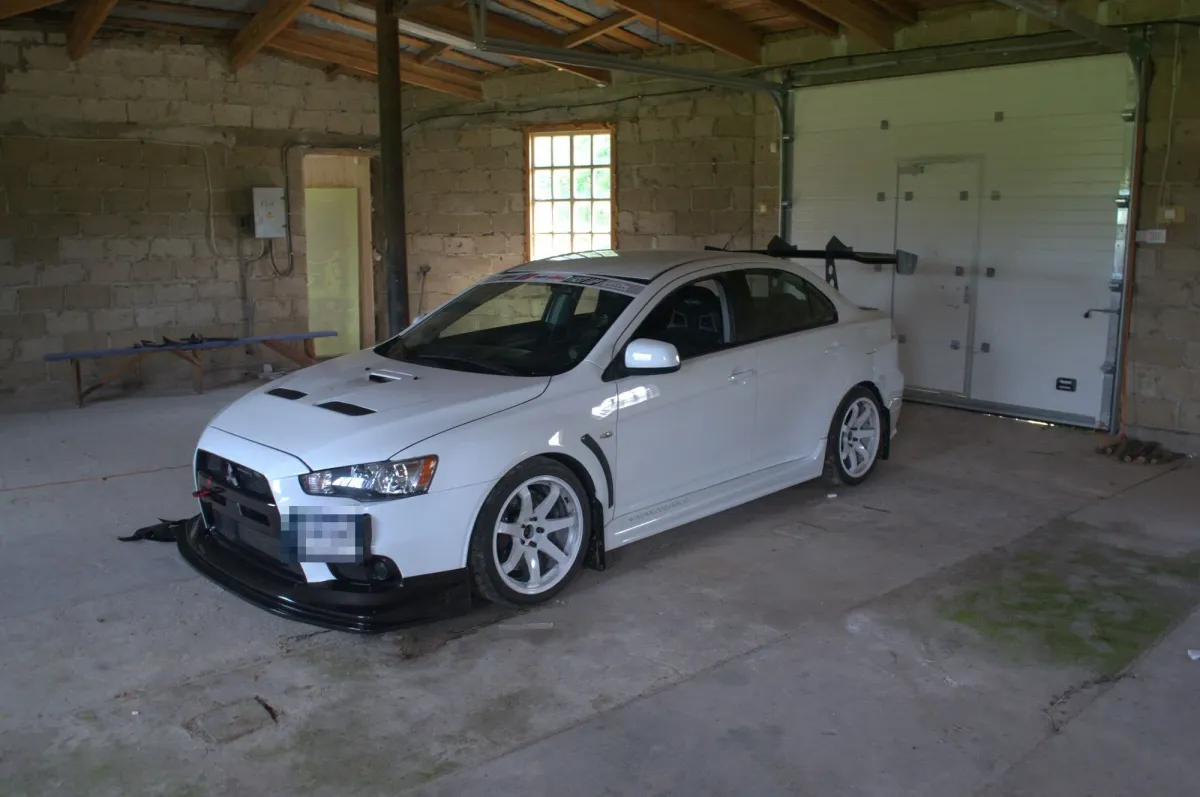
A dry garage beats any cover. The white Evolution X below, with a large black splitter and a GT wing, sits in a block-built garage. A building like this keeps the rain off, but a bare concrete floor and closed doors still need air moving through them.
Lockton recommends washing and drying the car fully first, a soft indoor cover, and dehumidifying crystals inside the car against mould. Auto Express adds that the cover should be breathable, not a plastic sheet that traps moisture.
Battery care
Yuasa, the battery maker, says all batteries lose charge over time, and alarms and electrical systems add to the drain even with the engine off. It also says that when charge drops below 80% and is not brought back up, permanent damage begins.
With a mains socket, use a smart charger (a maintainer) that can stay connected and cuts back when the battery is full. If there is no power, disconnecting the battery stops the drain, but Auto Express warns that modern on-board computers can be affected by a long disconnection.
Tyres, brakes and fuel
Continental says flat spots are usually temporary, but a tyre that stands under load for a month or more can get semi-permanent flat spots that normal driving will not remove. It advises adding about 3 psi before a long park, never above the maximum cold pressure on the sidewall.
Axle stands, on a hard, level floor, take the weight off the tyres completely. On a lowered car, use a low-profile jack and the jacking points in the handbook. Never lift under a splitter, a diffuser or the splitter support rods: they hold an aero part in place, not the weight of the car.
On level ground, leave the handbrake off: Auto Express warns a handbrake left on risks fusing the pads to the discs. Leave the car in gear, or in Park on an automatic, and chock the wheels front and back instead.
On fuel, the sources differ. Auto Express says brim the tank to limit condensation; Lockton says at least a quarter of a tank, with E5 and a fuel stabiliser. GOV.UK says classic and older cars, and some models from the early 2000s, may not be compatible with E10; its E10 checker tells you, and E5 super (97+ octane) is still sold at many filling stations.
Back on the road in spring
- Before the car moves, set the tyre pressures back to normal, reconnect or unplug the battery, remove the chocks and test the brakes at walking pace on private ground.
- Check the MOT date. GOV.UK says you cannot tax a car with an expired MOT, but you may drive it to a pre-booked test.
- Put road insurance back on before the car moves on a public road, including that drive to the MOT.
- Tax the car. That cancels the SORN automatically.
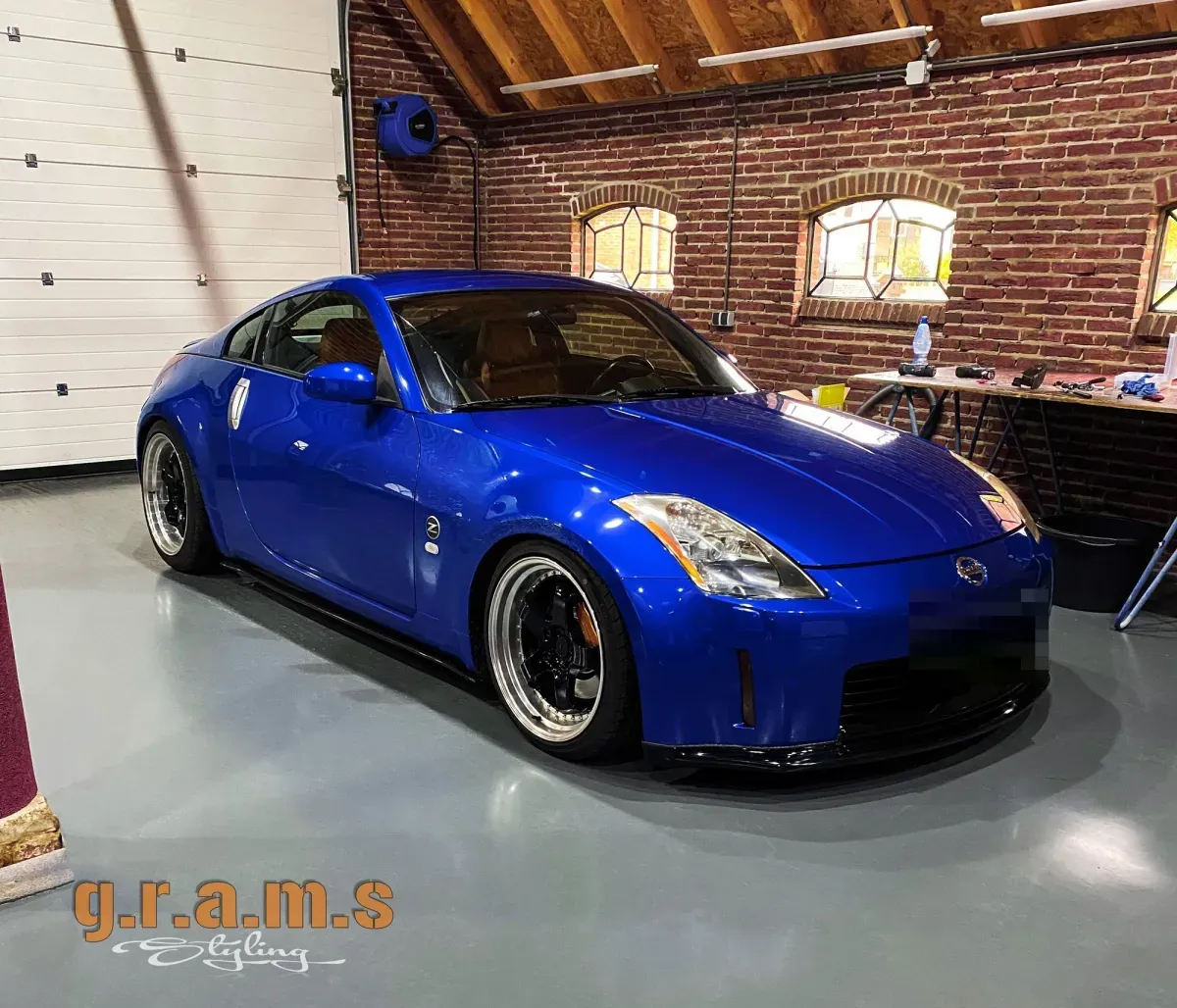
The blue 350Z in our header photo shows the ideal: a dry, lit garage with a painted floor. More owners' cars are in our Nissan and Mitsubishi galleries.
FAQ
Do I need insurance for a SORN car?
No. GOV.UK says you do not need to insure a vehicle that is kept off the road and declared SORN. Many owners still buy laid-up cover, which protects against fire and theft, and sometimes accidental damage, while the car is parked.
Can I keep a SORN car on my driveway?
Yes. GOV.UK counts a garage, a drive or private land as off the road. A SORN car cannot be kept on a public road, so a car that lives on the street must stay taxed and insured. Check your laid-up policy too: some insurers want the car garaged.
Can I drive a SORN car to an MOT?
Yes, but only to or from a pre-booked MOT or other test. The car still needs road insurance for that drive. Using a SORN car on the road for any other reason can lead to a fine of up to £2,500.
Should I disconnect my car battery over winter?
If you have a mains socket, a smart charger that stays connected is the better option. Yuasa says permanent damage begins when a battery drops below 80% charge and is not recharged. With no power, disconnecting stops the drain, but some modern cars do not like a long disconnection.
More from the blog
Are body kits, spoilers and GT wings legal in the UK? MOT, insurance and TÜV explained
What the MOT manual actually says about spoilers and body kits, why the MOT has no size rule for a GT wing, what you must tell your insurer, and how TÜV works for EU buyers. With the exact sources.

Nissan Skyline R32, R33 and R34 aero guide: GT-R vs GT-T body fitment
Skyline R32, R33 and R34 aero explained: GT-R vs GTS-t and GT-T bodies, coupe vs sedan, R33 series changes, Z-Tune style parts and fitting notes.

New Toyota Celica: what we know, and why the old Celicas still matter
What we know about the new Toyota Celica: what Toyota has said, Autocar's hybrid 4WD report, the 2027 WRC prototype and aero for older Celicas.